<?xml version="1.0" encoding="utf-8"?><feed xmlns="http://www.w3.org/2005/Atom" xml:lang="en-GB"><generator uri="https://jekyllrb.com/" version="3.10.0">Jekyll</generator><link href="https://swabi.co.uk/blog/feed.xml" rel="self" type="application/atom+xml" /><link href="https://swabi.co.uk/" rel="alternate" type="text/html" hreflang="en-GB" /><updated>2026-11-04T07:31:21+00:00</updated><id>https://swabi.co.uk/blog/feed.xml</id><title type="html">Swabi</title><subtitle>Swabi helps UK investors and businesses get their crypto tax right: capital gains, staking and DeFi income, HMRC disclosures, backdated reporting and tax planning. Book a free discovery call.</subtitle><entry><title type="html">Budget 2026: what it means for your crypto</title><link href="https://swabi.co.uk/blog/budget-2026-crypto/" rel="alternate" type="text/html" title="Budget 2026: what it means for your crypto" /><published>2026-10-28T15:00:00+00:00</published><updated>2026-10-28T15:00:00+00:00</updated><id>https://swabi.co.uk/blog/budget-2026-crypto</id><content type="html" xml:base="https://swabi.co.uk/blog/budget-2026-crypto/"><![CDATA[<p>The government has confirmed two changes that matter for anyone holding crypto. One is good news for DeFi users. The other gives HMRC more power to ask crypto platforms about their customers. Both are going into Finance Bill 2026-27, so neither is law yet.</p>

<!--more-->

<h2 id="1-crypto-loans-and-liquidity-pools">1. Crypto loans and liquidity pools</h2>

<p><img src="/assets/blog/budget-2026-crypto-2.jpg" alt="Lending and liquidity pools" /></p>

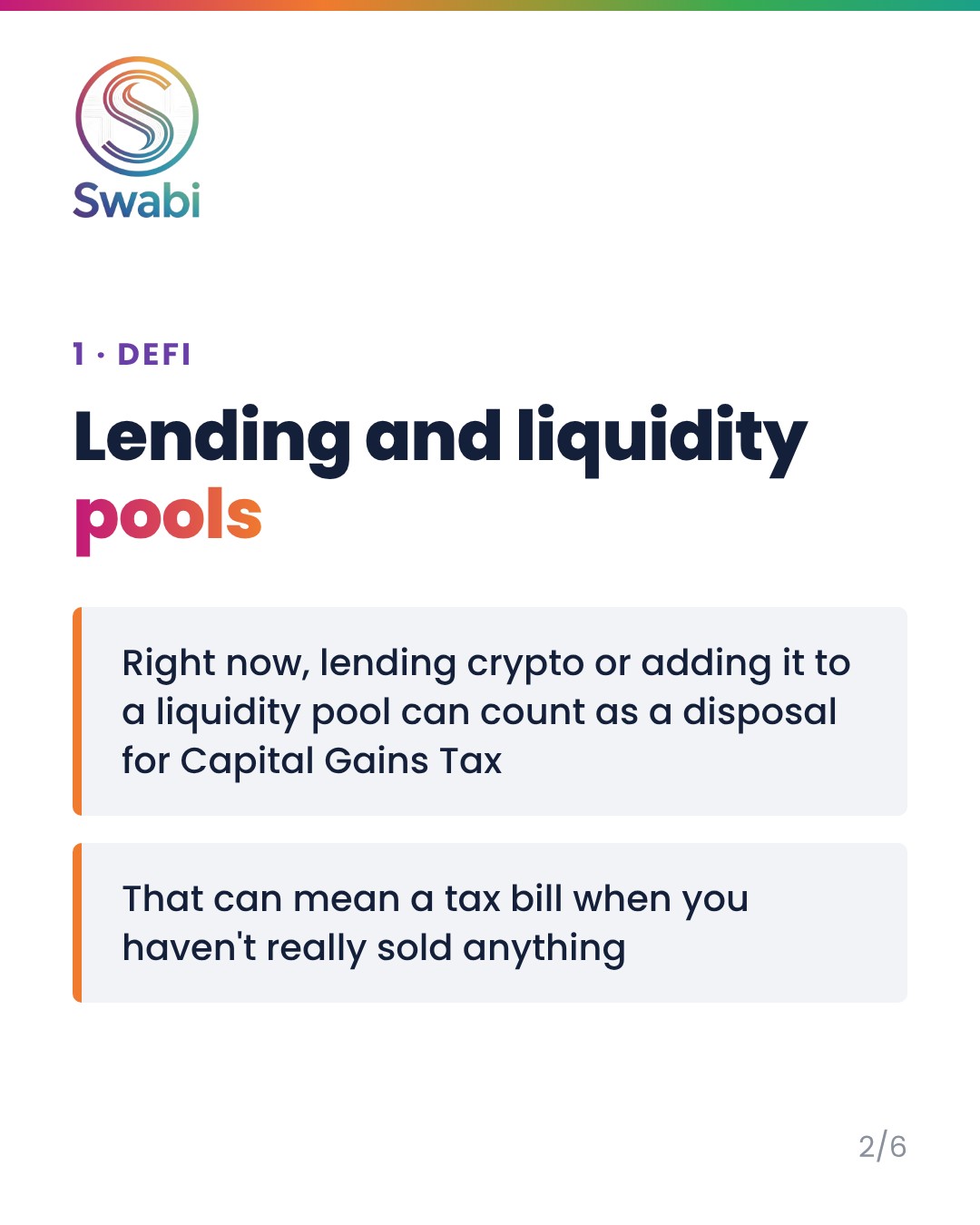
<p>Right now, lending your crypto or adding it to a liquidity pool can count as a disposal for Capital Gains Tax. That can mean a tax bill even though you haven’t really sold anything.</p>

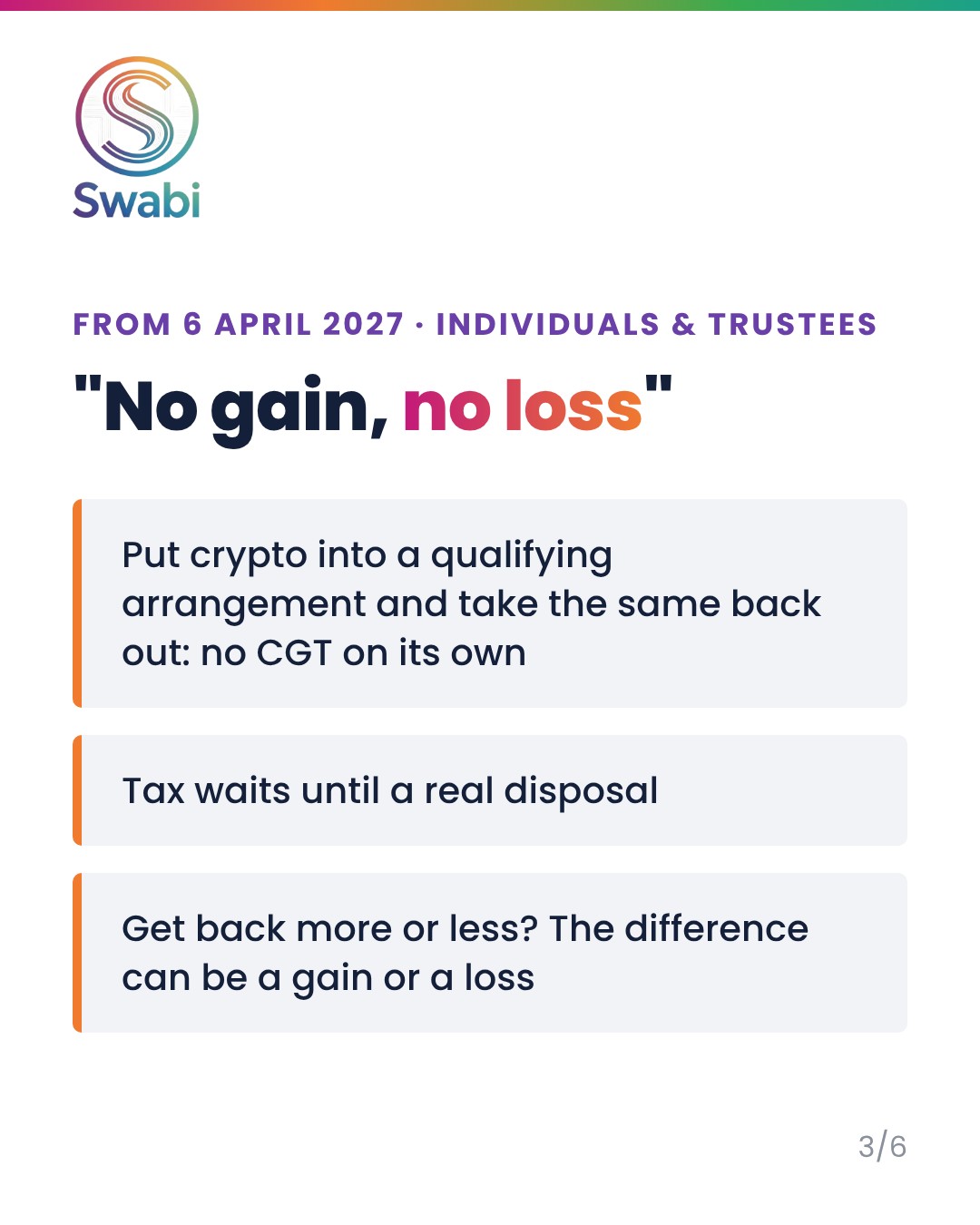
<p>As announced at Budget 2026, this will change from <strong>6 April 2027</strong>. For individuals and trustees, certain transfers into and out of qualifying lending arrangements and liquidity pools will be treated as <strong>“no gain, no loss”</strong> until there is a real (economic) disposal.</p>

<p><img src="/assets/blog/budget-2026-crypto-3.jpg" alt="No gain, no loss from 6 April 2027" /></p>

<p>In plain English: putting crypto in and taking the same crypto back out shouldn’t trigger Capital Gains Tax on its own. If you get back more or less than you put in, the difference can still be a taxable gain or a loss.</p>

<h2 id="2-hmrc-can-ask-crypto-platforms-for-information">2. HMRC can ask crypto platforms for information</h2>

<p><img src="/assets/blog/budget-2026-crypto-4.jpg" alt="HMRC can ask crypto platforms" /></p>

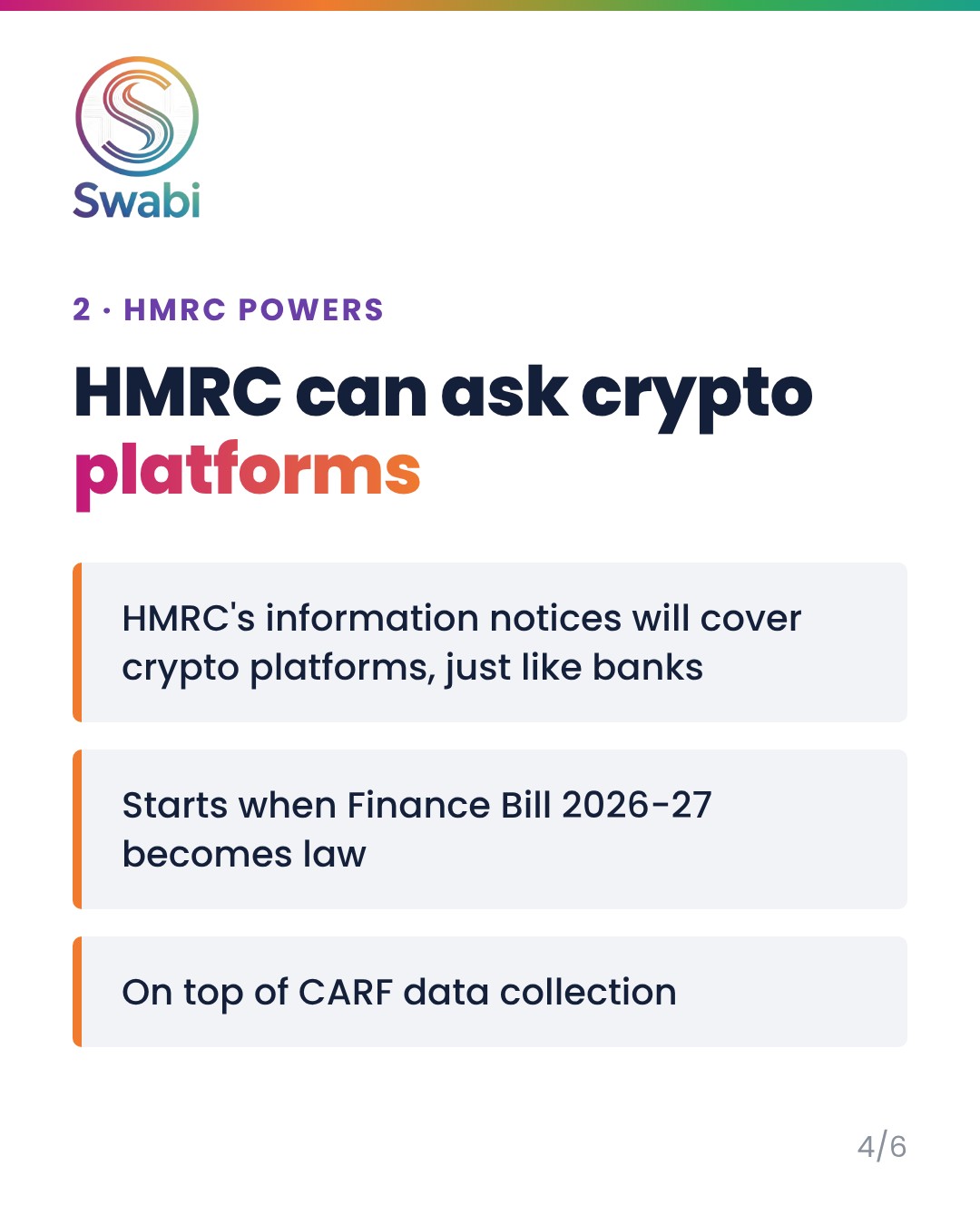
<p>HMRC’s civil information and inspection powers are being modernised. One change expands the Financial Institution Notice, which HMRC already uses to ask banks for information about customers, to include cryptoasset service providers. This takes effect when Finance Bill 2026-27 becomes law.</p>

<p>That comes on top of <a href="/blog/carf-hmrc-can-now-see-your-crypto/">CARF</a>, which already has UK platforms collecting their users’ details and transactions for HMRC.</p>

<h2 id="what-to-do-now">What to do now</h2>

<p><img src="/assets/blog/budget-2026-crypto-5.jpg" alt="What to do now" /></p>

<ol>
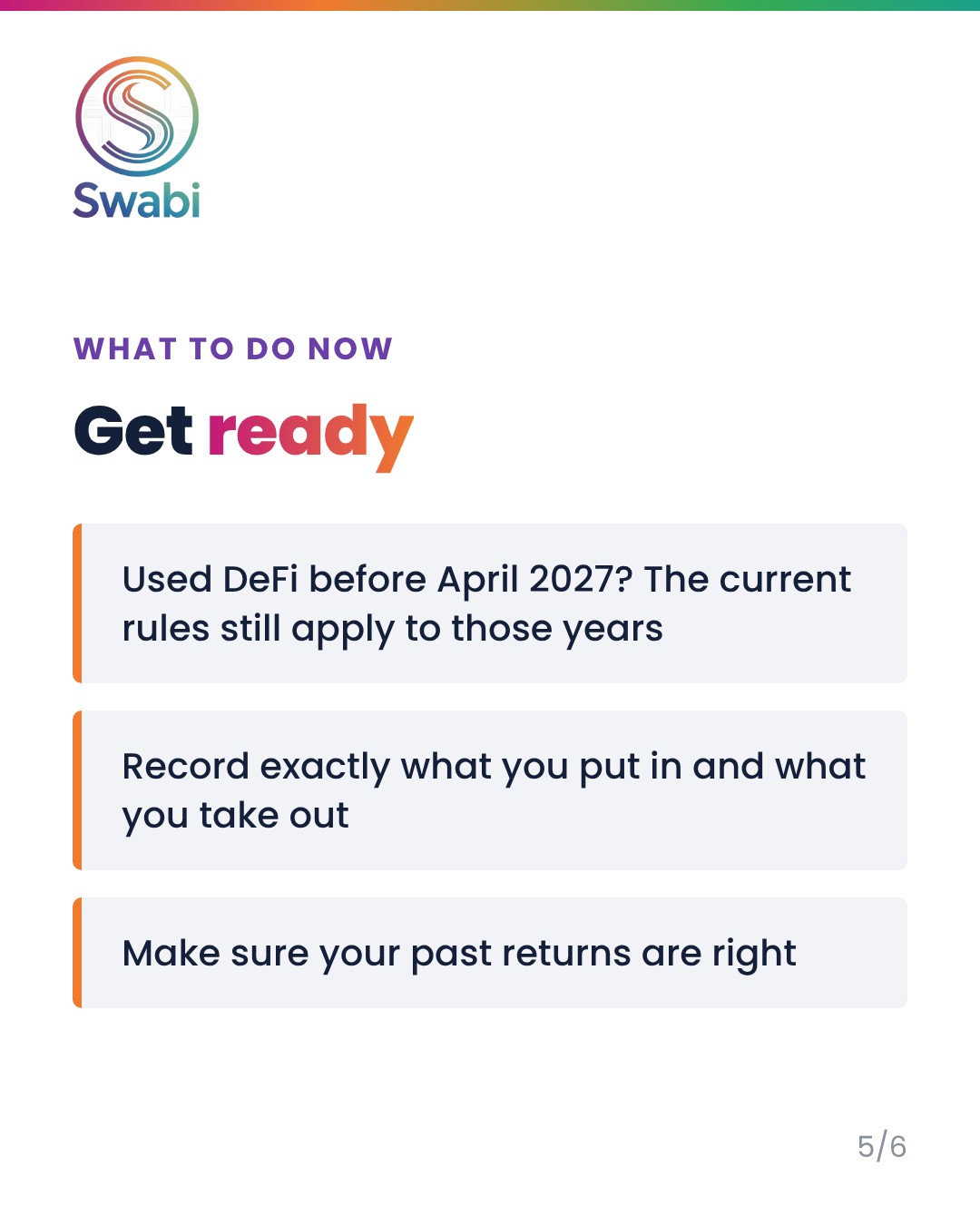
  <li><strong>Used lending or liquidity pools before April 2027?</strong> The current rules still apply to those years.</li>
  <li><strong>Keep records</strong> of exactly what you put in and what you took out, and when.</li>
  <li><strong>Check your past returns.</strong> It is far better to put things right yourself than to wait for HMRC to ask.</li>
</ol>

<p>Not sure how DeFi has affected your tax? <a href="/#contact">Get in touch</a>. Call or WhatsApp 07488 883219, or email contact@swabi.co.uk.</p>

<p><em>General guidance, not financial or tax advice.</em></p>

<h2 id="sources">Sources</h2>

<ul>
  <li><a href="https://www.gov.uk/guidance/check-if-you-need-to-pay-tax-when-you-sell-cryptoassets">HMRC: Check if you need to pay tax when you sell cryptoassets</a></li>
  <li><a href="https://hansard.parliament.uk/commons/2026-07-13/debates/26071334000012/FinanceBill2026-27DraftLegislationAndTaxDocuments">Hansard: Finance Bill 2026-27, draft legislation and tax documents</a></li>
  <li><a href="https://news.bitcoin.com/uk-hmrc-says-crypto-lending-will-trigger-no-capital-gains-tax-until-economic-disposal/">Bitcoin.com: UK HMRC says crypto lending will trigger no Capital Gains Tax until economic disposal</a></li>
</ul>]]></content><author><name>Sham Sadiq</name></author><category term="Budget" /><category term="DeFi" /><category term="HMRC" /><category term="Capital Gains Tax" /><summary type="html"><![CDATA[Two changes in Finance Bill 2026-27: 'no gain, no loss' for crypto lending and liquidity pools from April 2027, and new HMRC powers to ask crypto platforms for information.]]></summary><media:thumbnail xmlns:media="http://search.yahoo.com/mrss/" url="https://swabi.co.uk/assets/blog/budget-2026-crypto-1.jpg" /><media:content medium="image" url="https://swabi.co.uk/assets/blog/budget-2026-crypto-1.jpg" xmlns:media="http://search.yahoo.com/mrss/" /></entry><entry><title type="html">UK crypto tax in 2026: 5 things you need to know</title><link href="https://swabi.co.uk/blog/uk-crypto-tax-2026-highlights/" rel="alternate" type="text/html" title="UK crypto tax in 2026: 5 things you need to know" /><published>2026-10-26T09:00:00+00:00</published><updated>2026-10-26T09:00:00+00:00</updated><id>https://swabi.co.uk/blog/uk-crypto-tax-2026-highlights</id><content type="html" xml:base="https://swabi.co.uk/blog/uk-crypto-tax-2026-highlights/"><![CDATA[<p>2026 has been one of the biggest years yet for UK crypto tax. HMRC is getting more data, the rules are tightening, and the figures show it is paying attention. Here are five things you need to know.</p>

<!--more-->

<video controls="" playsinline="" preload="metadata" style="width:100%;max-width:420px;border-radius:12px"><source src="/assets/blog/uk-crypto-tax-2026-highlights.mp4" type="video/mp4" /></video>

<h2 id="1-hmrc-can-see-more-january">1. HMRC can see more (January)</h2>

<p>From 1 January 2026, UK crypto platforms started collecting their users’ details and transactions under CARF, the Cryptoasset Reporting Framework. The first reports go to HMRC in 2027, covering the 2026 calendar year.</p>

<p>That means HMRC will be able to compare what platforms report with what you declare on your tax return. <a href="/blog/carf-hmrc-can-now-see-your-crypto/">Read more about CARF</a>.</p>

<h2 id="2-crypto-etns-left-the-stocks-and-shares-isa-april">2. Crypto ETNs left the Stocks and Shares ISA (April)</h2>

<p>Crypto exchange-traded notes (ETNs) are products listed on a stock exchange that track the price of crypto. Since 6 April 2026 they only qualify for an Innovative Finance ISA, not a Stocks and Shares ISA. Held in a normal account, any gains can face Capital Gains Tax.</p>

<h2 id="3-the-fca-finalised-its-crypto-rules-june">3. The FCA finalised its crypto rules (June)</h2>

<p>The Financial Conduct Authority published its final rules for UK crypto firms on 30 June 2026. They are expected to come into force on 25 October 2027, bringing stricter rules on how platforms hold your crypto. Crypto stays high risk, and the new rules do not change how it is taxed. <a href="/blog/fca-crypto-rules-what-changes/">Read what changes for investors</a>.</p>

<h2 id="4-more-warning-letters">4. More warning letters</h2>

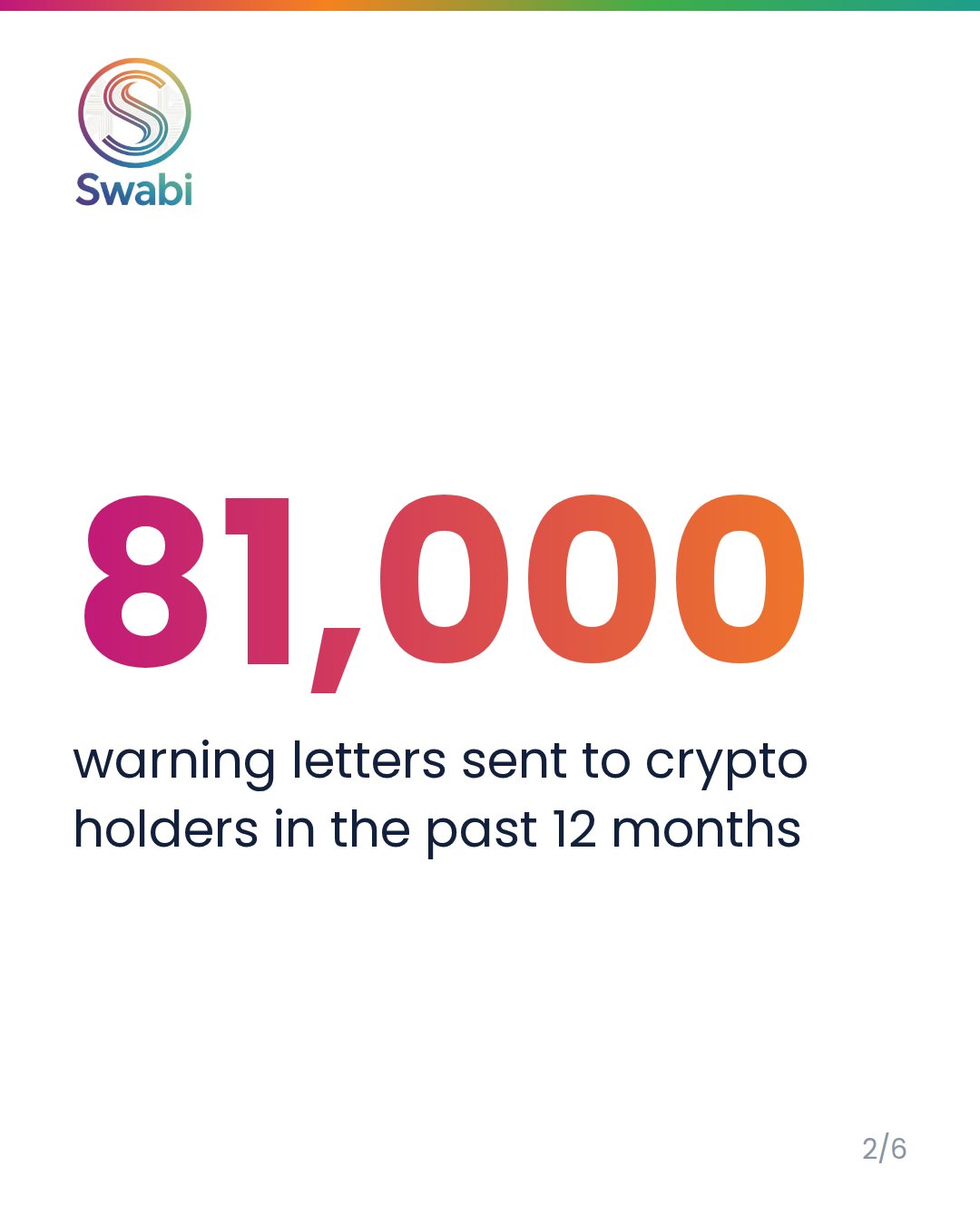
<p>Around 81,000 crypto warning letters went out in 12 months, up about a quarter on the 65,000 sent the year before. These figures were reported by UHY Hacker Young and are not official HMRC statistics. A letter is not a penalty, but it should not be ignored. <a href="/blog/hmrc-crypto-warning-letters/">Read what to do if you get one</a>.</p>

<h2 id="5-hmrcs-first-official-crypto-figures">5. HMRC’s first official crypto figures</h2>

<p>HMRC published its first ever official figures on crypto gains. For the 2024 to 2025 tax year, 17,600 people declared crypto gains, and 240 of them declared gains of more than £1 million each. HMRC estimates its compliance work raised an extra £168 million. <a href="/blog/hmrc-first-crypto-tax-figures/">Read more about the figures</a>.</p>

<h2 id="whats-next">What’s next</h2>

<p>The Budget is on 28 October 2026, and changes to Capital Gains Tax have been widely discussed. Nothing has been confirmed yet. We will cover anything that affects crypto once it is announced.</p>

<h2 id="what-to-do-now">What to do now</h2>

<p>HMRC has never had more data on crypto. A good starting point is to:</p>

<ol>
  <li>Gather your transactions from every exchange and wallet you have used.</li>
  <li>Check that each sale, swap or spend, and the gain or loss on it, is recorded correctly.</li>
  <li>Put right any gaps before your next Self Assessment return.</li>
</ol>

<p>Not sure your records are right? <a href="/#contact">Get in touch</a>. Call or WhatsApp 07488 883219, or email contact@swabi.co.uk.</p>

<p><em>General guidance, not financial or tax advice.</em></p>

<h2 id="sources">Sources</h2>

<ul>
  <li><a href="https://www.gov.uk/guidance/check-if-you-need-to-pay-tax-when-you-sell-cryptoassets">HMRC: Check if you need to pay tax when you sell cryptoassets</a></li>
  <li><a href="https://www.gov.uk/government/news/240-crypto-millionaires-revealed-in-new-government-data">HMRC: 240 crypto millionaires revealed in new government data</a></li>
  <li><a href="https://www.fca.org.uk/publications/policy-statements/cryptoasset-regime">FCA: Overview of our cryptoassets regime policy statements</a></li>
  <li><a href="https://cryptobriefing.com/hmrc-crypto-tax-warning-letters/">Crypto Briefing: HMRC sends 81,000 warning letters to crypto holders</a></li>
  <li><a href="https://www.techtimes.com/articles/326801/20260906/hargreaves-lansdown-opens-bitcoin-etns-two-million-clients-minus-isa-shelter.htm">Tech Times: Hargreaves Lansdown opens Bitcoin ETNs, minus ISA shelter</a></li>
</ul>]]></content><author><name>Sham Sadiq</name></author><category term="HMRC" /><category term="CARF" /><category term="FCA" /><category term="Capital Gains Tax" /><summary type="html"><![CDATA[CARF, crypto ETNs leaving ISAs, the FCA's final rules, more HMRC letters and HMRC's first crypto figures. Here is what has happened in UK crypto tax this year.]]></summary><media:thumbnail xmlns:media="http://search.yahoo.com/mrss/" url="https://swabi.co.uk/assets/blog/uk-crypto-tax-2026-highlights-1.jpg" /><media:content medium="image" url="https://swabi.co.uk/assets/blog/uk-crypto-tax-2026-highlights-1.jpg" xmlns:media="http://search.yahoo.com/mrss/" /></entry><entry><title type="html">Posting about crypto isn’t knowing crypto</title><link href="https://swabi.co.uk/blog/posting-about-crypto-isnt-knowing-crypto/" rel="alternate" type="text/html" title="Posting about crypto isn’t knowing crypto" /><published>2026-10-24T07:30:00+01:00</published><updated>2026-10-24T07:30:00+01:00</updated><id>https://swabi.co.uk/blog/posting-about-crypto-isnt-knowing-crypto</id><content type="html" xml:base="https://swabi.co.uk/blog/posting-about-crypto-isnt-knowing-crypto/"><![CDATA[<p>Recently I went to a networking event for accountants. When it came to introductions, I said I’m a crypto accountant. Literally the next day, one of the accountants from that room posted about crypto tax.</p>

<!--more-->

<video controls="" playsinline="" preload="metadata" style="width:100%;max-width:420px;border-radius:12px"><source src="/assets/blog/posting-about-crypto-isnt-knowing-crypto.mp4" type="video/mp4" /></video>

<p>I’ll be honest, that annoyed me. Not because they shared something. Because of what it suggests.</p>

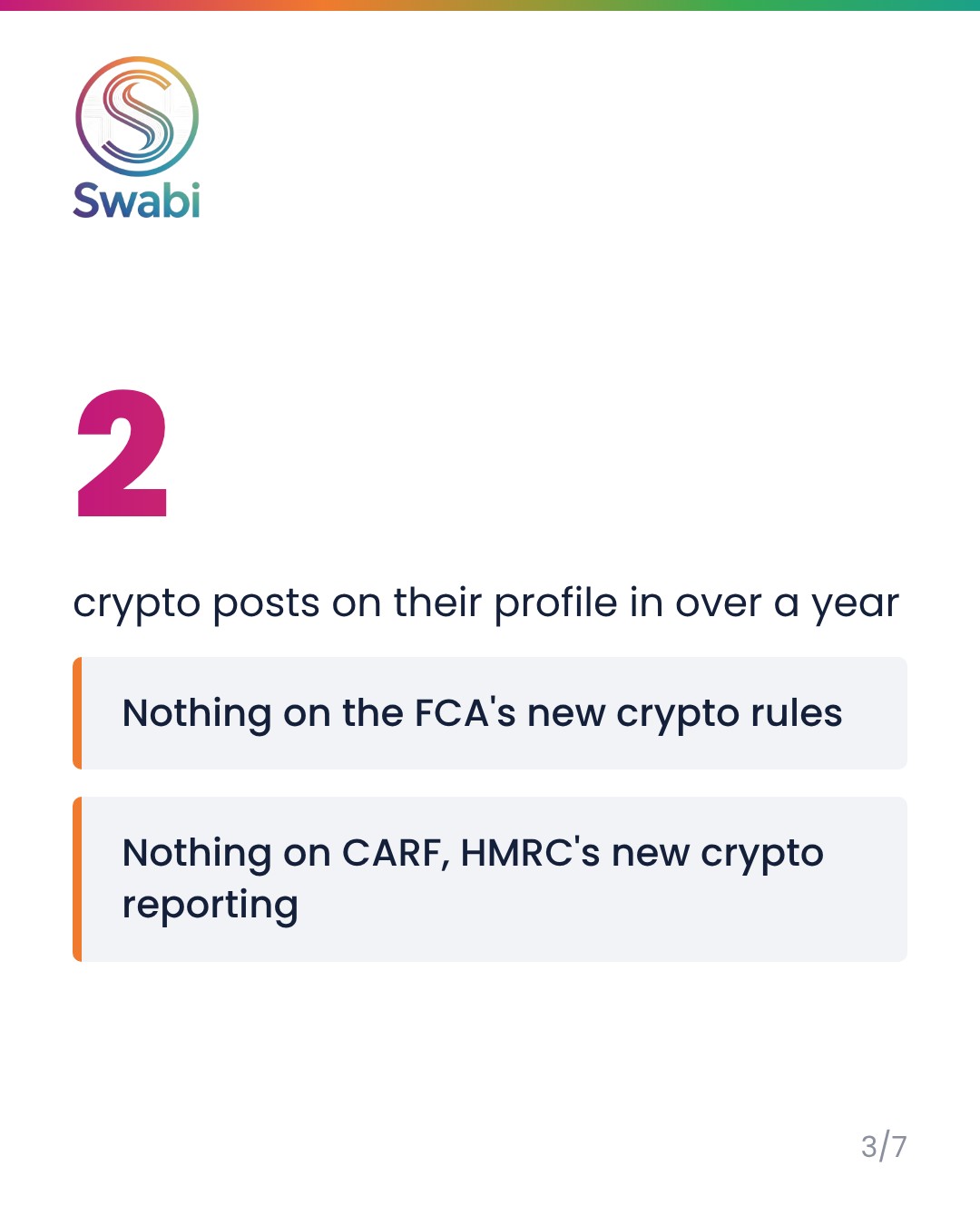
<h2 id="two-posts-in-over-a-year">Two posts in over a year</h2>

<p><img src="/assets/blog/posting-about-crypto-isnt-knowing-crypto-3.jpg" alt="2 crypto posts in over a year" /></p>

<p>I had a look at their profile. In over a year of posts, crypto had come up twice.</p>

<p>And this has been one of the biggest years for UK crypto tax and regulation:</p>

<ul>
  <li>The FCA published its <a href="/blog/fca-crypto-rules-what-changes/">final rules for UK crypto firms</a>.</li>
  <li>CARF, the Cryptoasset Reporting Framework, means <a href="/blog/carf-hmrc-can-now-see-your-crypto/">HMRC now gets data straight from crypto platforms</a>.</li>
  <li>HMRC published its <a href="/blog/hmrc-first-crypto-tax-figures/">first ever official crypto tax figures</a>.</li>
</ul>

<p>Not a word on any of it.</p>

<h2 id="same-post-different-logo">Same post, different logo</h2>

<p><img src="/assets/blog/posting-about-crypto-isnt-knowing-crypto-4.jpg" alt="Same post, different logo" /></p>

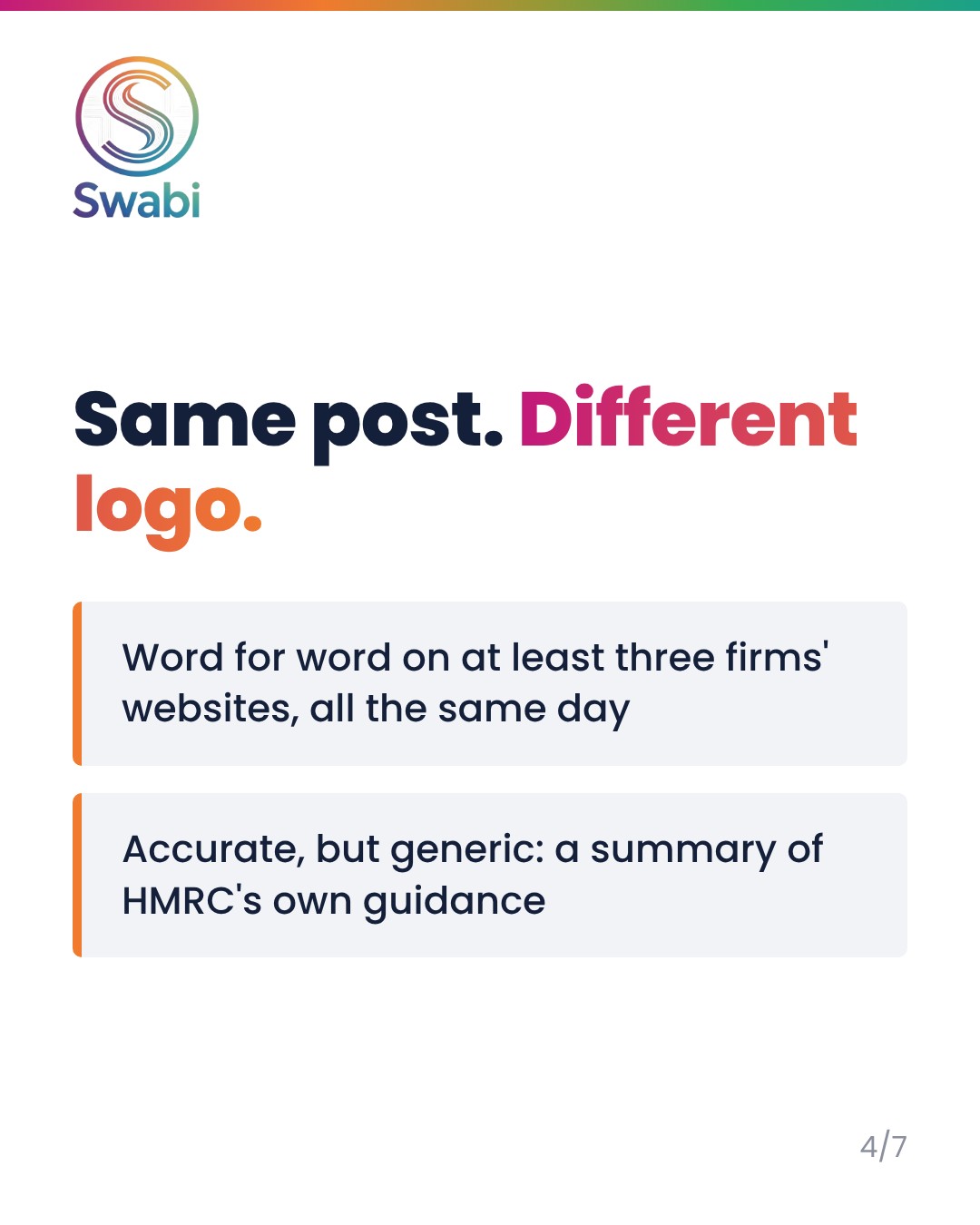
<p>Then I noticed something else. The same article, word for word, had appeared on at least three other accounting firms’ websites on the same day. Same headline, same eight points. Just a different logo on each.</p>

<p>To be fair, the content is fine. It’s a summary of HMRC’s own guidance. But that’s the point. Anyone can share it. Sharing it borrows the credibility of a specialist area, without the expertise to back it up.</p>

<h2 id="crypto-tax-needs-specialist-knowledge">Crypto tax needs specialist knowledge</h2>

<p><img src="/assets/blog/posting-about-crypto-isnt-knowing-crypto-5.jpg" alt="Crypto tax needs specialist knowledge" /></p>

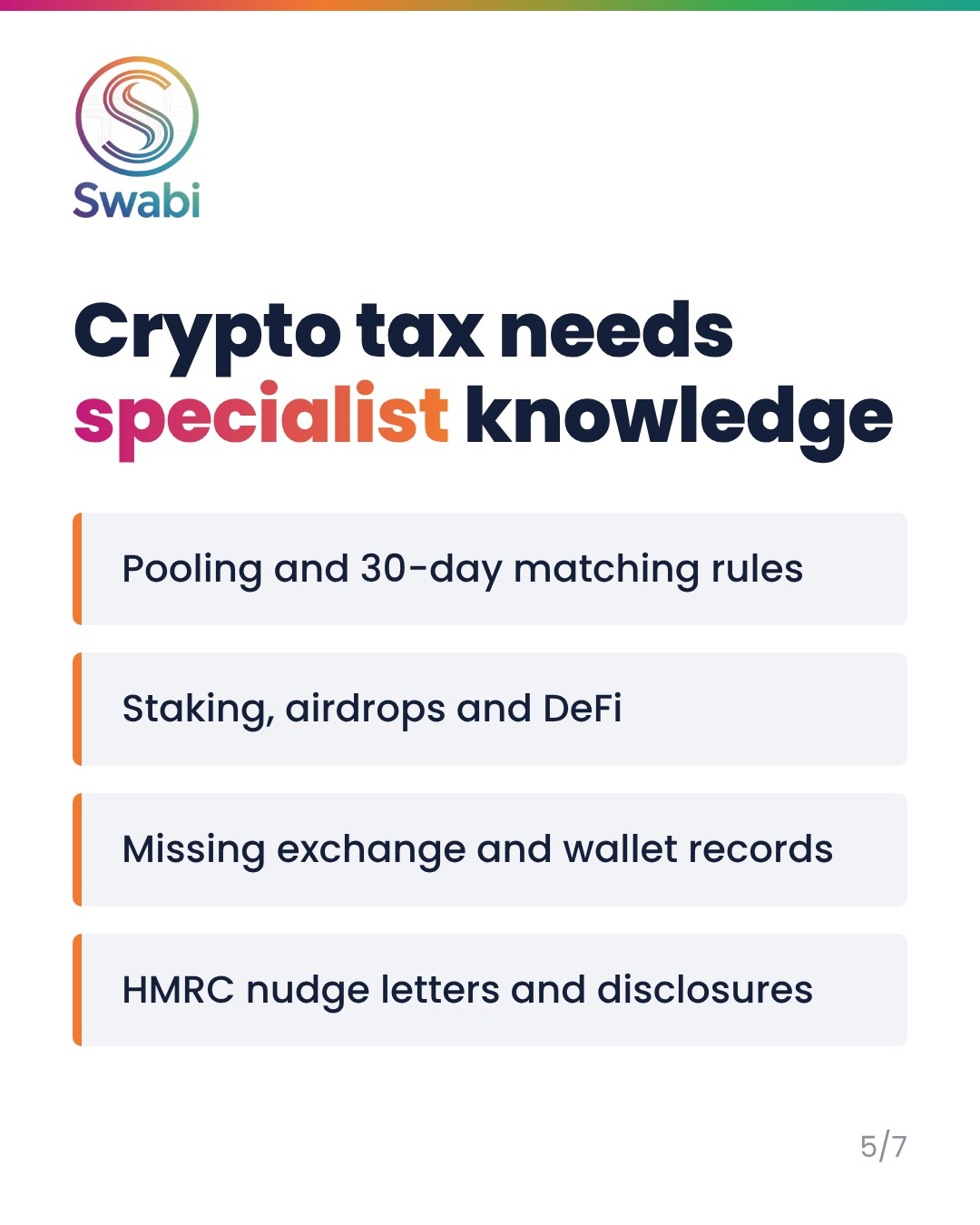
<p>Crypto tax isn’t a side topic. It means things like:</p>

<ul>
  <li>Matching disposals under HMRC’s pooling and 30-day rules</li>
  <li>Working out whether staking, airdrops and DeFi count as income or gains</li>
  <li>Rebuilding records across exchanges and wallets, some of which no longer exist</li>
  <li>Dealing with HMRC nudge letters and voluntary disclosures</li>
</ul>

<p>Get it wrong and it’s the client who pays the tax, interest and penalties.</p>

<h2 id="what-to-ask-your-accountant">What to ask your accountant</h2>

<p><img src="/assets/blog/posting-about-crypto-isnt-knowing-crypto-6.jpg" alt="Ask your accountant" /></p>

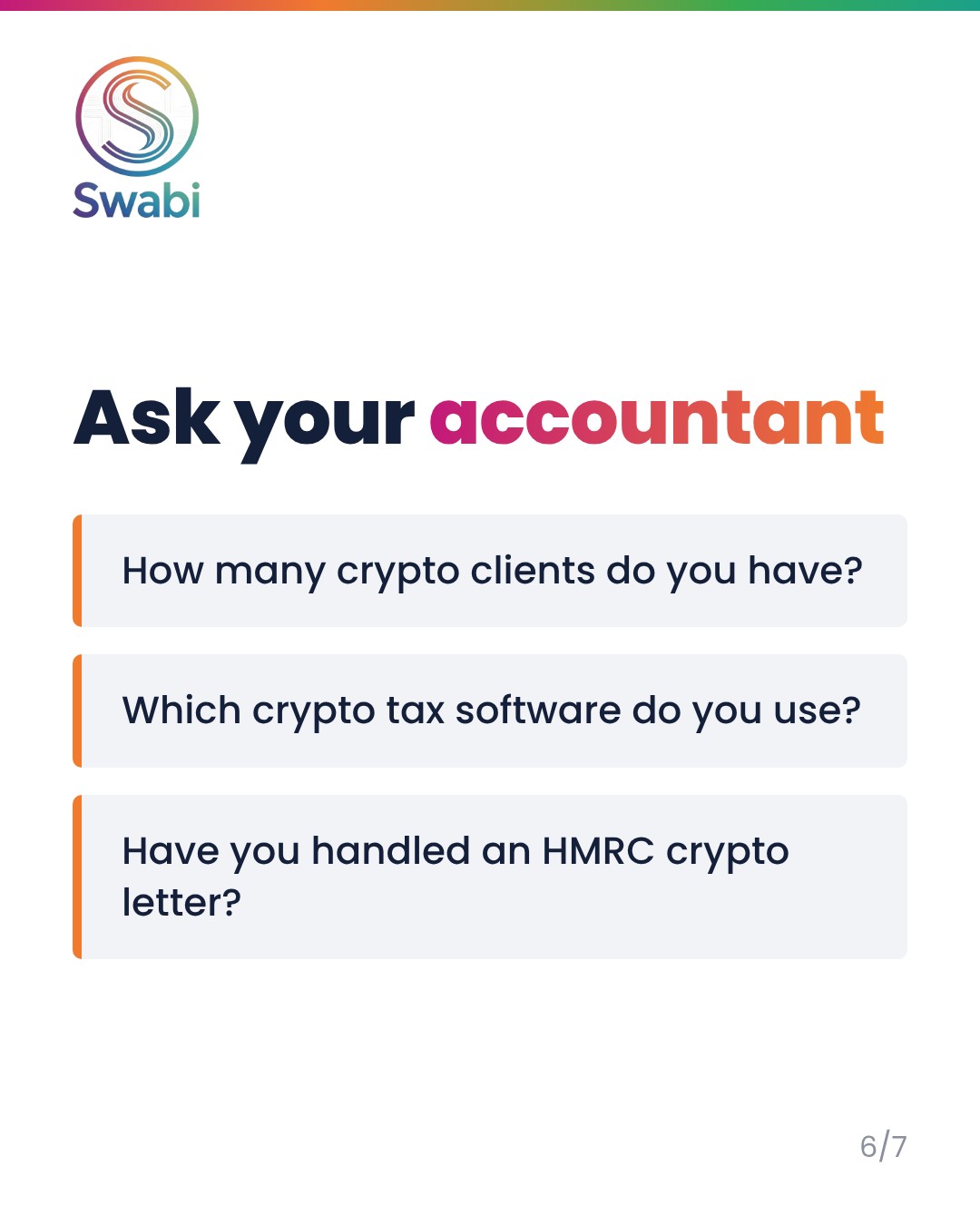
<p>If you’re choosing an accountant for your crypto, ask them:</p>

<ol>
  <li>How many crypto clients do you work with?</li>
  <li>Which crypto tax software do you use, and why?</li>
  <li>How would you treat my staking rewards or DeFi activity?</li>
  <li>Have you handled an HMRC crypto nudge letter or disclosure?</li>
</ol>

<p>A good accountant will be happy to answer. A specialist will enjoy it.</p>

<p>And look at their history. Have they been talking about crypto, and the changes that matter, for years? Or did it start last week?</p>

<p>Real expertise leaves a trail.</p>

<p>If you’d like to talk to someone who does this every day, <a href="/#contact">get in touch</a>. Call or WhatsApp 07488 883219, or email contact@swabi.co.uk.</p>

<p><em>General guidance, not financial or tax advice.</em></p>

<h2 id="sources">Sources</h2>

<ul>
  <li><a href="https://www.gov.uk/guidance/check-if-you-need-to-pay-tax-when-you-sell-cryptoassets">HMRC: Check if you need to pay tax when you sell cryptoassets</a></li>
  <li><a href="https://www.fca.org.uk/publications/policy-statements/cryptoasset-regime">FCA: Overview of our cryptoassets regime policy statements</a></li>
</ul>]]></content><author><name>Sham Sadiq</name></author><category term="Crypto Tax" /><category term="Choosing an Accountant" /><summary type="html"><![CDATA[Plenty of accountants post about crypto tax. Fewer actually specialise in it. Here is how to tell the difference before you trust anyone with your crypto.]]></summary><media:thumbnail xmlns:media="http://search.yahoo.com/mrss/" url="https://swabi.co.uk/assets/blog/posting-about-crypto-isnt-knowing-crypto-1.jpg" /><media:content medium="image" url="https://swabi.co.uk/assets/blog/posting-about-crypto-isnt-knowing-crypto-1.jpg" xmlns:media="http://search.yahoo.com/mrss/" /></entry><entry><title type="html">The UK’s new crypto rules: what changes for investors</title><link href="https://swabi.co.uk/blog/fca-crypto-rules-what-changes/" rel="alternate" type="text/html" title="The UK’s new crypto rules: what changes for investors" /><published>2026-10-22T23:00:00+01:00</published><updated>2026-10-22T23:00:00+01:00</updated><id>https://swabi.co.uk/blog/fca-crypto-rules-what-changes</id><content type="html" xml:base="https://swabi.co.uk/blog/fca-crypto-rules-what-changes/"><![CDATA[<p>The Financial Conduct Authority (FCA) has published its final rules for UK crypto firms. They are expected to come into force on 25 October 2027, and they bring new protections for people who buy and hold crypto.</p>

<!--more-->

<video controls="" playsinline="" preload="metadata" style="width:100%;max-width:420px;border-radius:12px"><source src="/assets/blog/fca-crypto-rules-what-changes.mp4" type="video/mp4" /></video>

<h2 id="what-has-happened">What has happened?</h2>

<p>On 30 June 2026 the FCA published its final rules and guidance for crypto firms. They build on new law passed by Parliament on 4 February 2026.</p>

<p>Crypto firms can now apply to the FCA for permission to operate under the new rules. The application window opened on 30 September 2026 and closes on 28 February 2027. The full regime is expected to start on 25 October 2027.</p>

<h2 id="your-crypto-better-protected">Your crypto, better protected</h2>

<p><img src="/assets/blog/fca-crypto-rules-what-changes-3.jpg" alt="Your crypto, better protected" /></p>

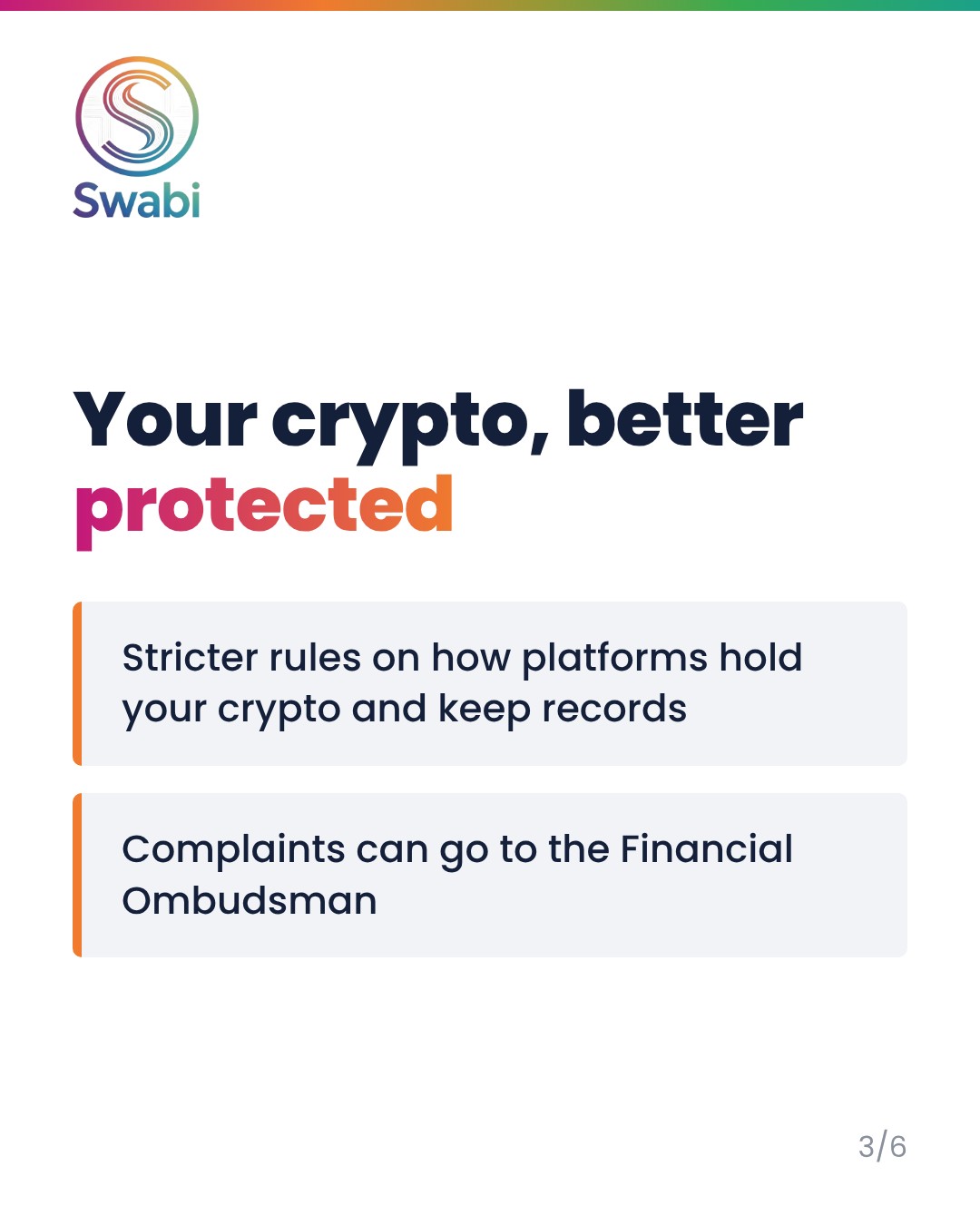
<p>Platforms that hold crypto for customers will face stricter rules. The FCA says these cover ownership rights, record keeping, regular checks that records match, and how private keys are managed.</p>

<p>You will also be able to take complaints about authorised firms to the Financial Ombudsman Service, a free, independent body that settles disputes.</p>

<h2 id="clearer-terms">Clearer terms</h2>

<p><img src="/assets/blog/fca-crypto-rules-what-changes-4.jpg" alt="Clearer terms for stablecoins, staking and crypto loans" /></p>

<ul>
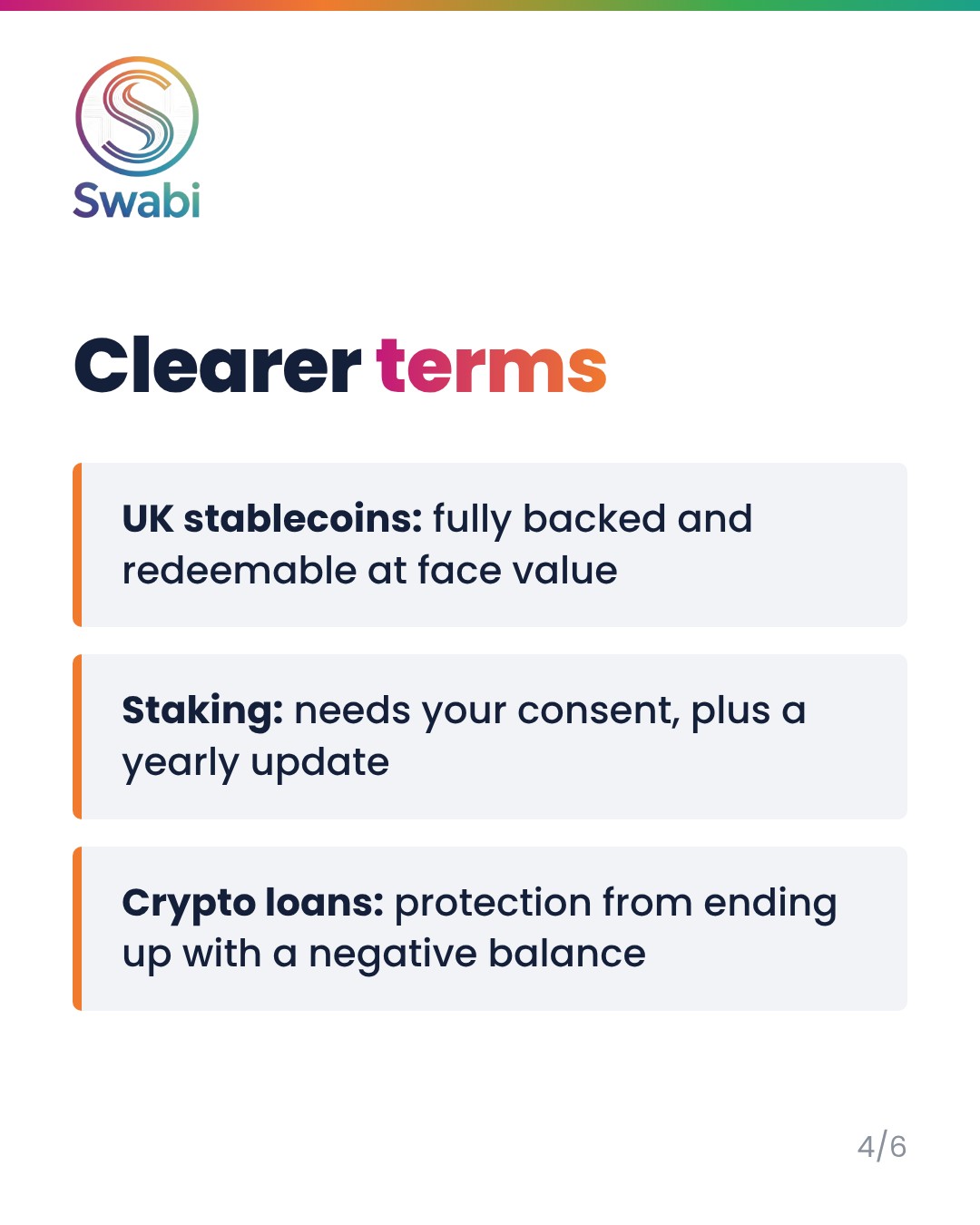
  <li><strong>Stablecoins.</strong> UK-issued stablecoins must be fully backed and redeemable at face value. A stablecoin is a token designed to hold a steady value, usually £1 or $1.</li>
  <li><strong>Staking.</strong> Staking means locking up crypto to help run a network in return for rewards. Firms will need clear terms and your consent, and must update you each year.</li>
  <li><strong>Crypto loans.</strong> Retail customers get protections including clear information, an appropriateness test and negative balance protection, so you should not end up owing more than you put in.</li>
</ul>

<h2 id="still-high-risk">Still high risk</h2>

<p><img src="/assets/blog/fca-crypto-rules-what-changes-5.jpg" alt="Crypto is still high risk" /></p>

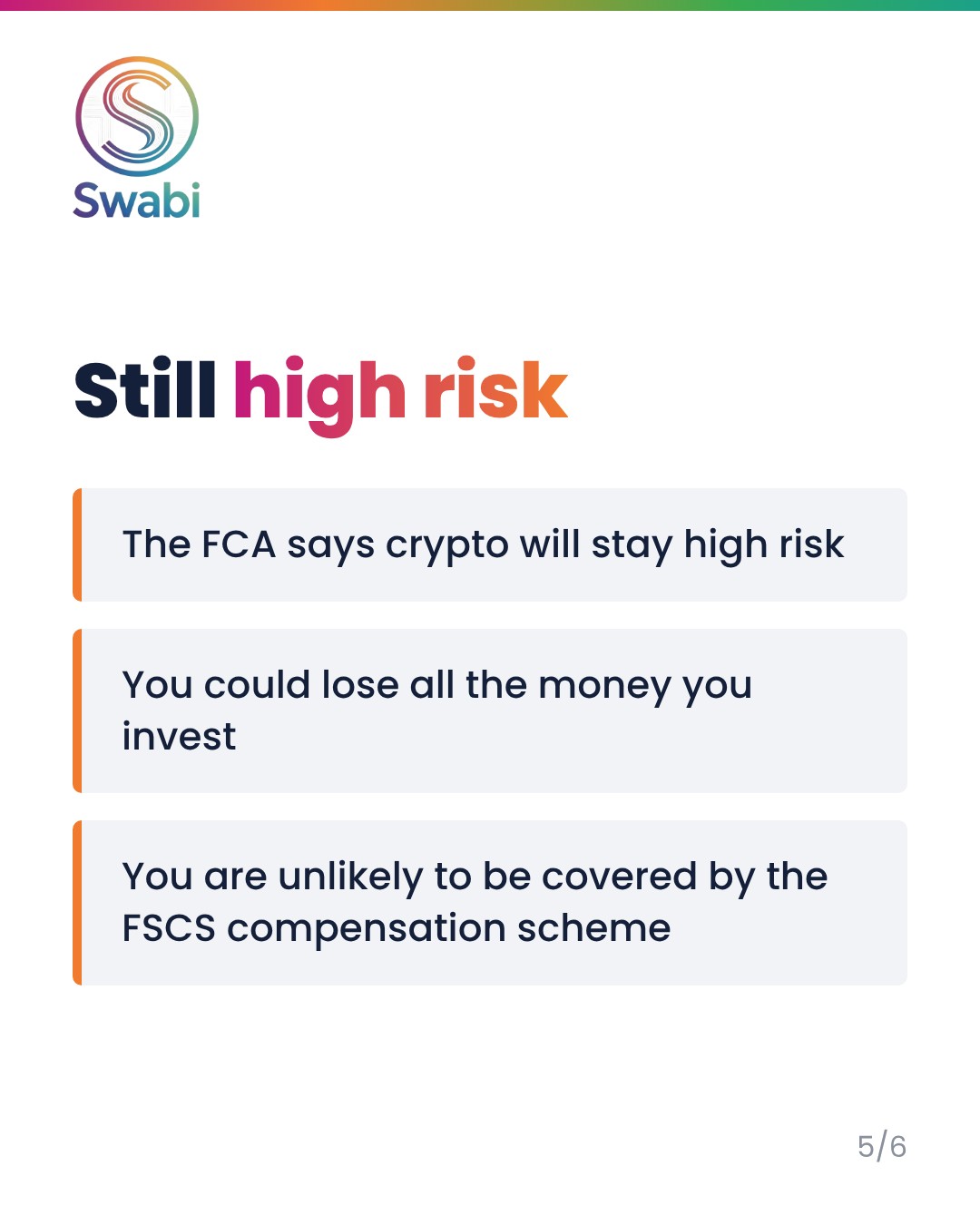
<p>The FCA is clear that crypto “will remain high risk” under the new regime. You could lose all the money you invest. You are also unlikely to be covered by the Financial Services Compensation Scheme (FSCS) if a crypto firm fails.</p>

<h2 id="what-about-tax">What about tax?</h2>

<p>The new rules are about how firms are regulated. They do not change how your crypto is taxed. Selling, swapping or spending crypto can still mean Capital Gains Tax, and staking rewards can count as income.</p>

<p>HMRC is also getting more information from crypto platforms under the Cryptoasset Reporting Framework. You can read more in our post on <a href="/blog/carf-hmrc-can-now-see-your-crypto/">what CARF means for UK investors</a>.</p>

<p>If you are not sure your crypto tax is right, <a href="/#contact">get in touch</a>. Call or WhatsApp 07488 883219, or email contact@swabi.co.uk.</p>

<p><em>General guidance, not financial or tax advice.</em></p>

<h2 id="sources">Sources</h2>

<ul>
  <li><a href="https://www.fca.org.uk/publications/policy-statements/cryptoasset-regime">FCA: Overview of our cryptoassets regime policy statements</a></li>
  <li><a href="https://www.fca.org.uk/firms/new-regime-cryptoasset-regulation">FCA: New regime for cryptoasset regulation</a></li>
  <li><a href="https://www.mondaq.com/uk/corporate-and-company-law/1839830/fca-finalises-the-uk-crypto-regime">Eversheds Sutherland via Mondaq: FCA finalises the UK crypto regime (8 September 2026)</a></li>
</ul>]]></content><author><name>Sham Sadiq</name></author><category term="FCA" /><category term="Regulation" /><category term="Compliance" /><summary type="html"><![CDATA[The FCA has published its final rules for UK crypto firms, expected to start on 25 October 2027. Here is what they mean for you, and what they don't change.]]></summary><media:thumbnail xmlns:media="http://search.yahoo.com/mrss/" url="https://swabi.co.uk/assets/blog/fca-crypto-rules-what-changes-1.jpg" /><media:content medium="image" url="https://swabi.co.uk/assets/blog/fca-crypto-rules-what-changes-1.jpg" xmlns:media="http://search.yahoo.com/mrss/" /></entry><entry><title type="html">HMRC proposes a new crime for reckless tax errors: what it means</title><link href="https://swabi.co.uk/blog/hmrc-reckless-tax-statements/" rel="alternate" type="text/html" title="HMRC proposes a new crime for reckless tax errors: what it means" /><published>2026-10-22T00:00:00+01:00</published><updated>2026-10-22T00:00:00+01:00</updated><id>https://swabi.co.uk/blog/hmrc-reckless-tax-statements</id><content type="html" xml:base="https://swabi.co.uk/blog/hmrc-reckless-tax-statements/"><![CDATA[<p>HMRC has proposed a new criminal offence for reckless untrue statements on direct tax. It is a proposal, not yet law, and HMRC says honest mistakes are not meant to be covered.</p>

<!--more-->

<video controls="" playsinline="" preload="metadata" style="width:100%;max-width:420px;border-radius:12px"><source src="/assets/blog/hmrc-reckless-tax-statements.mp4" type="video/mp4" /></video>

<h2 id="what-is-proposed">What is proposed</h2>

<p>The offence would apply to untrue statements or declarations on direct taxes such as Income Tax and Corporation Tax. VAT and other indirect taxes already have a similar offence. It would cover individuals, companies, trustees and tax agents.</p>

<h2 id="what-does-reckless-mean">What does “reckless” mean?</h2>

<p>In HMRC’s consultation, reckless means knowing there is a risk that a statement might be wrong, and going ahead anyway without proper checks. If prosecutors could not prove deliberate dishonesty, they could use this lesser offence instead.</p>

<h2 id="what-about-honest-mistakes">What about honest mistakes?</h2>

<p>HMRC says genuine mistakes, misunderstandings and failing to take reasonable care are not intended to be covered. These would stay a civil matter, such as a penalty. Examples HMRC gave of conduct that could be covered include claiming a large relief without checking the guidance despite suspecting it might be wrong, or leaving out income from an account you suspected you should declare.</p>

<h2 id="where-does-it-stand">Where does it stand?</h2>

<p>The proposed maximum is up to two years in prison, an unlimited fine, or both. HMRC’s consultation closed on 16 August 2026 and HMRC is still considering the responses. There is no timetable yet. The Chartered Institute of Taxation has said the boundaries between careless, reckless and deliberate conduct are not clear, and ICAEW does not support the offence.</p>

<h2 id="what-to-do">What to do</h2>

<p>Whatever happens, the best protection is accurate records and proper checks before you file. If you report crypto gains or losses, that means:</p>

<ol>
  <li>Gathering your transactions from every exchange and wallet.</li>
  <li>Checking each disposal and the gain or loss on it.</li>
  <li>Keeping a clear record of how you worked out each figure.</li>
</ol>

<p>Not sure your records are right? <a href="/#contact">Get in touch with Swabi</a> and we’ll help you get them in order.</p>

<p><em>This article is general guidance, not personal tax advice.</em></p>

<h2 id="sources">Sources</h2>

<ul>
  <li><a href="https://www.which.co.uk/news/article/new-hmrc-tax-rules-could-criminalise-reckless-errors-what-you-need-to-know-adIzx3Y0OZPA">Which?: New HMRC tax rules could criminalise ‘reckless’ errors</a></li>
  <li><a href="https://www.burges-salmon.com/articles/102nbv4/a-shift-beyond-dishonesty-proposed-criminal-offence-for-reckless-untrue-tax-stat">Burges Salmon: A shift beyond dishonesty, proposed criminal offence for reckless untrue tax statements</a></li>
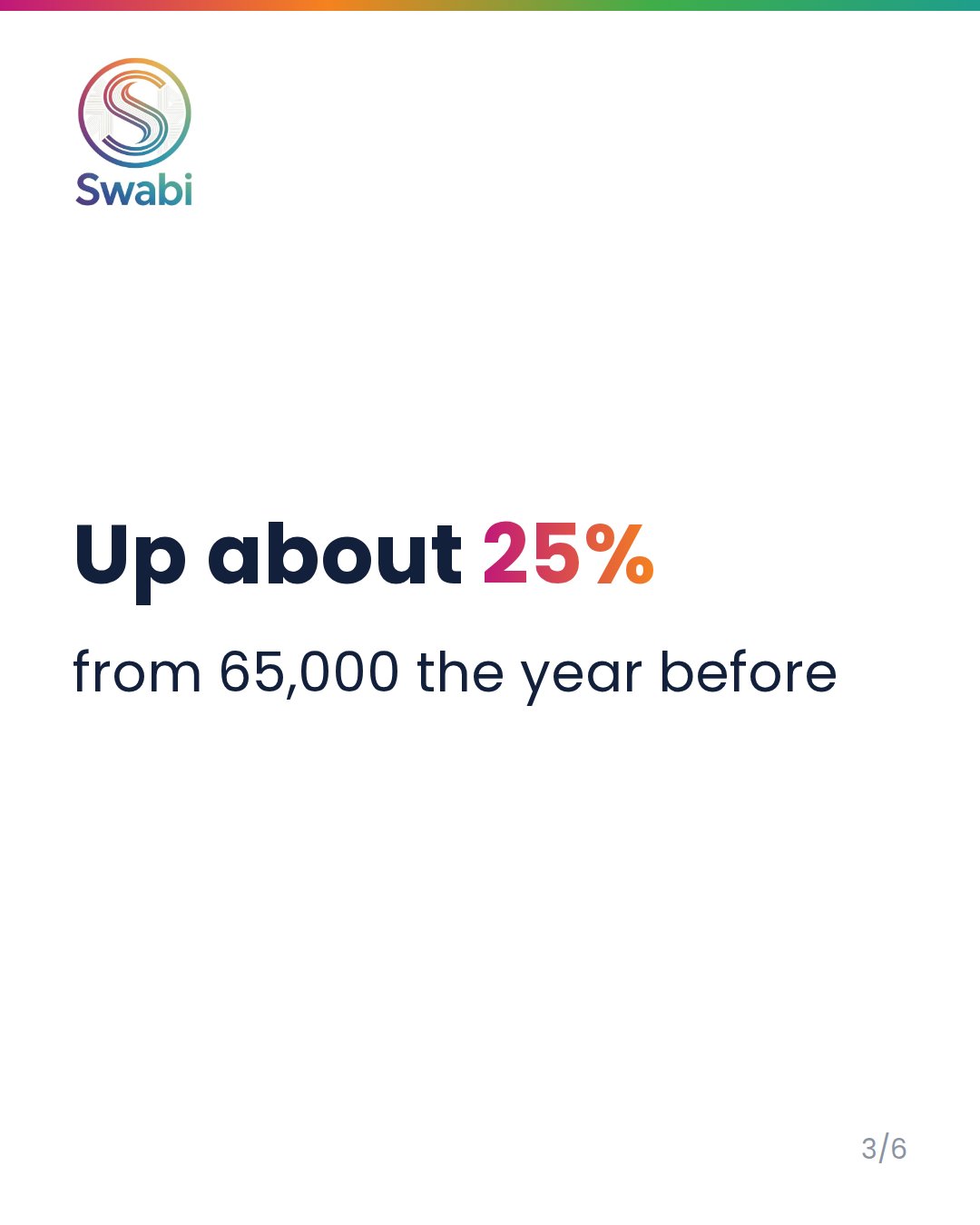
</ul>]]></content><author><name>Sham Sadiq</name></author><category term="HMRC" /><category term="Compliance" /><category term="Self Assessment" /><summary type="html"><![CDATA[HMRC has proposed a criminal offence for reckless untrue statements on direct tax. Here is what is proposed, what 'reckless' means, and what honest mistakes look like.]]></summary></entry><entry><title type="html">HMRC is sending more crypto tax warning letters: what to do</title><link href="https://swabi.co.uk/blog/hmrc-crypto-warning-letters/" rel="alternate" type="text/html" title="HMRC is sending more crypto tax warning letters: what to do" /><published>2026-10-20T00:00:00+01:00</published><updated>2026-10-20T00:00:00+01:00</updated><id>https://swabi.co.uk/blog/hmrc-crypto-warning-letters</id><content type="html" xml:base="https://swabi.co.uk/blog/hmrc-crypto-warning-letters/"><![CDATA[<p>HMRC is sending far more crypto tax warning letters. Figures reported by UHY Hacker Young show about 81,000 went out in the past 12 months, up around 25% on the 65,000 sent the year before.</p>

<!--more-->

<p><img src="/assets/blog/hmrc-crypto-warning-letters-2.jpg" alt="About 81,000 warning letters sent to crypto holders in the past 12 months" /></p>

<p><img src="/assets/blog/hmrc-crypto-warning-letters-3.jpg" alt="Up about 25% from 65,000 the year before" /></p>

<h2 id="what-the-figures-show">What the figures show</h2>

<ul>
  <li><strong>About 81,000</strong> letters were sent to crypto holders in the past 12 months.</li>
  <li>That is <strong>up about 25%</strong> from 65,000 the year before.</li>
</ul>

<p>These are figures reported by UHY Hacker Young, based on Freedom of Information data. They are not official HMRC statistics.</p>

<h2 id="what-the-letters-say">What the letters say</h2>

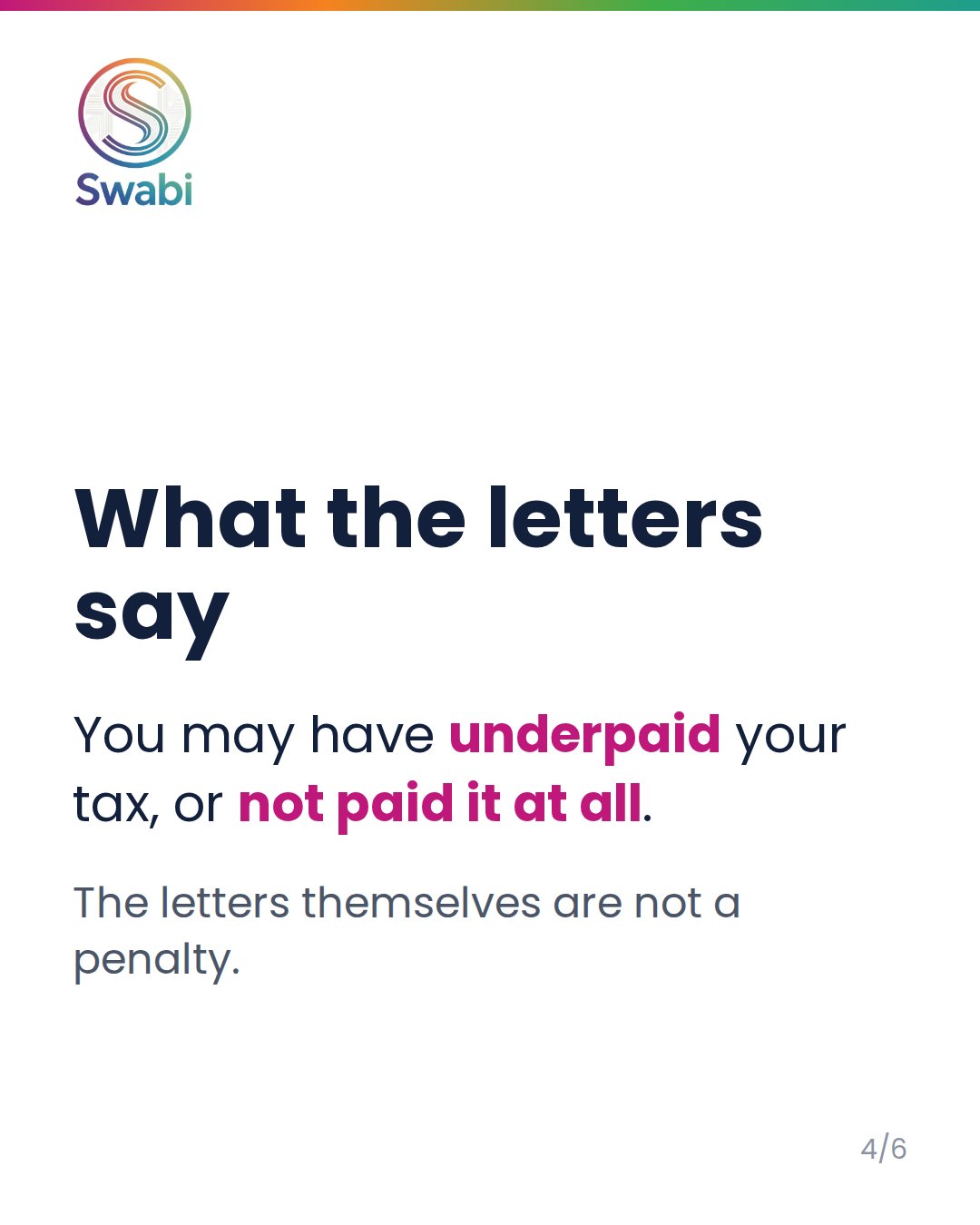
<p>The letters say you may have underpaid your tax, or not paid it at all. They focus on Capital Gains Tax on crypto, such as selling for pounds or swapping one token for another.</p>

<p><img src="/assets/blog/hmrc-crypto-warning-letters-4.jpg" alt="What the letters say" /></p>

<h2 id="a-letter-is-not-a-penalty">A letter is not a penalty</h2>

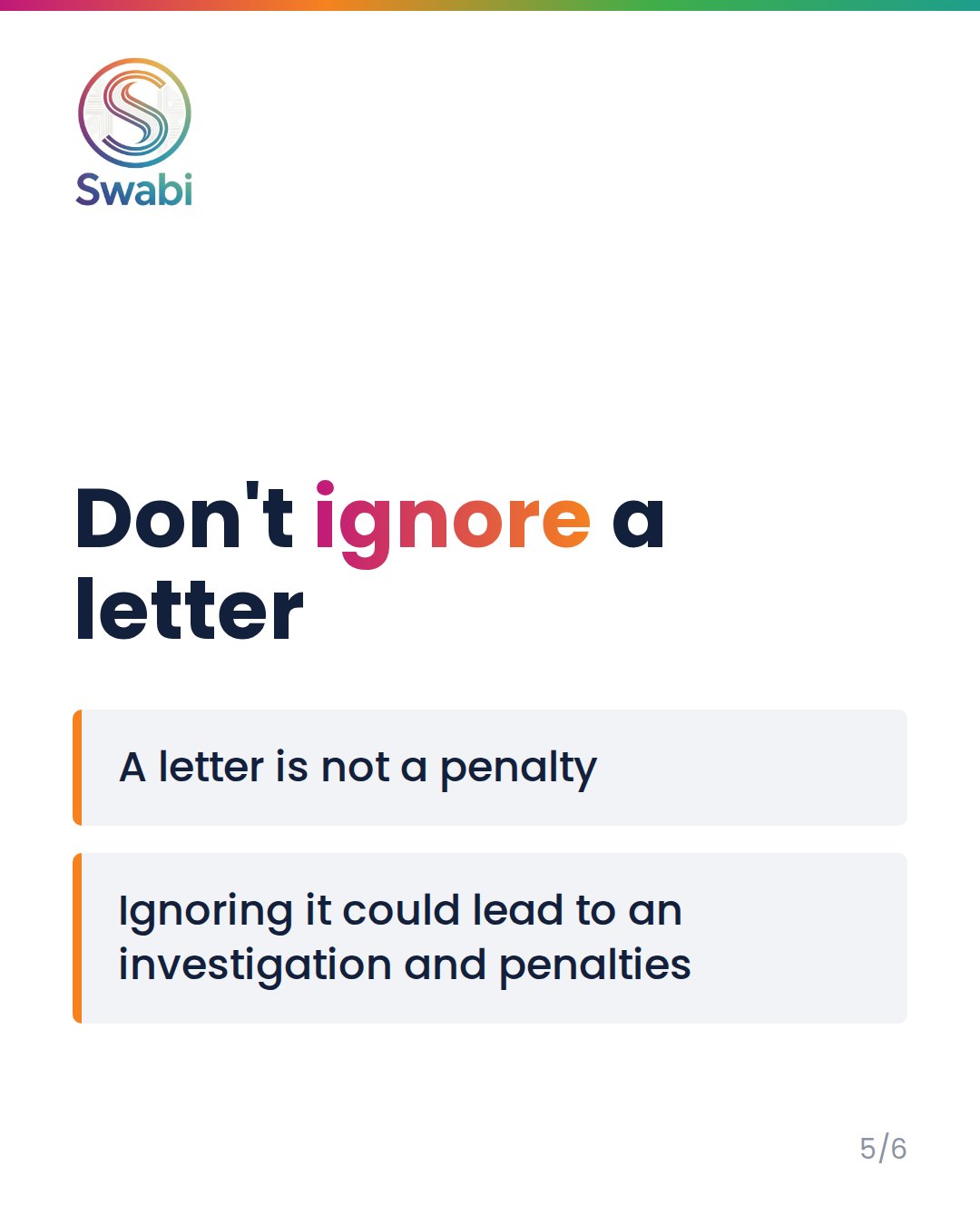
<p>Receiving a letter is not a penalty in itself. But ignoring it could lead to an investigation, and a formal investigation that finds unreported gains can lead to penalties.</p>

<p><img src="/assets/blog/hmrc-crypto-warning-letters-5.jpg" alt="Don't ignore a letter" /></p>

<h2 id="what-to-do">What to do</h2>

<ol>
  <li>Gather your transactions from every exchange and wallet.</li>
  <li>Check that each disposal and the gain or loss on it is recorded correctly.</li>
  <li>Fix any gaps or errors before your next Self Assessment return.</li>
</ol>

<p>If you’ve had a letter, or aren’t sure your records are right, <a href="/#contact">get in touch with Swabi</a> and we’ll help you get them in order.</p>

<p><em>This article is general guidance, not personal tax advice.</em></p>

<h2 id="sources">Sources</h2>

<ul>
  <li><a href="https://cryptobriefing.com/hmrc-crypto-tax-warning-letters/">Crypto Briefing: HMRC sends 81,000 warning letters to crypto holders</a></li>
  <li><a href="https://www.crowdfundinsider.com/2026/08/298960-hmrc-reportedly-sends-out-over-80000-letters-warning-crypto-investors-to-pay-their-taxes/">Crowdfund Insider: HMRC reportedly sends out over 80,000 letters</a></li>
</ul>]]></content><author><name>Sham Sadiq</name></author><category term="HMRC" /><category term="Capital Gains Tax" /><category term="Compliance" /><summary type="html"><![CDATA[About 81,000 crypto warning letters went out in the past 12 months, up around 25%. Here is what they say and what to do if you get one.]]></summary><media:thumbnail xmlns:media="http://search.yahoo.com/mrss/" url="https://swabi.co.uk/assets/blog/hmrc-crypto-warning-letters-1.jpg" /><media:content medium="image" url="https://swabi.co.uk/assets/blog/hmrc-crypto-warning-letters-1.jpg" xmlns:media="http://search.yahoo.com/mrss/" /></entry><entry><title type="html">HMRC publishes its first crypto tax figures: what they mean</title><link href="https://swabi.co.uk/blog/hmrc-first-crypto-tax-figures/" rel="alternate" type="text/html" title="HMRC publishes its first crypto tax figures: what they mean" /><published>2026-10-20T00:00:00+01:00</published><updated>2026-10-20T00:00:00+01:00</updated><id>https://swabi.co.uk/blog/hmrc-first-crypto-tax-figures</id><content type="html" xml:base="https://swabi.co.uk/blog/hmrc-first-crypto-tax-figures/"><![CDATA[<p>HMRC has published its first ever official figures on crypto gains. For the 2024 to 2025 tax year, 17,600 people declared gains, and HMRC says its compliance work raised an extra £168 million in tax.</p>

<!--more-->

<video controls="" playsinline="" preload="metadata" style="width:100%;max-width:420px;border-radius:12px"><source src="/assets/blog/hmrc-first-crypto-tax-figures.mp4" type="video/mp4" /></video>

<h2 id="what-the-figures-show">What the figures show</h2>

<ul>
  <li><strong>17,600 people</strong> declared crypto gains in 2024 to 2025.</li>
  <li><strong>£13.8 billion</strong> in disposal proceeds, which is the total value of crypto sold, swapped or spent.</li>
  <li><strong>£1.38 billion</strong> in declared gains, an average of about £78,000 per person.</li>
</ul>

<h2 id="the-big-earners">The big earners</h2>

<p><strong>240 people</strong> each declared gains of more than £1 million.</p>

<h2 id="hmrcs-compliance-work">HMRC’s compliance work</h2>

<p>HMRC estimates that its compliance and education work raised an extra <strong>£168 million</strong> in Capital Gains Tax for 2024 to 2025. This is an estimate, not a final figure.</p>

<h2 id="what-this-means-for-you">What this means for you</h2>

<p>Selling, swapping and spending crypto can all trigger tax. HMRC now publishes data on crypto gains, so accurate records matter more than ever. That applies to individuals filing Self Assessment and to companies that use crypto as a form of payment.</p>

<p>A good starting point is to:</p>

<ol>
  <li>Gather your transactions from every exchange and wallet.</li>
  <li>Check that gains and losses are recorded correctly for each disposal.</li>
  <li>Tidy up any gaps before your Self Assessment return.</li>
</ol>

<p>Not sure your crypto records are right? <a href="/#contact">Get in touch with Swabi</a> and we’ll help you get them in order.</p>

<p><em>This article is general guidance, not personal tax advice.</em></p>

<h2 id="sources">Sources</h2>

<ul>
  <li><a href="https://www.gov.uk/government/news/240-crypto-millionaires-revealed-in-new-government-data">HMRC: 240 crypto millionaires revealed in new government data (GOV.UK)</a></li>
</ul>]]></content><author><name>Sham Sadiq</name></author><category term="HMRC" /><category term="Capital Gains Tax" /><category term="Self Assessment" /><summary type="html"><![CDATA[HMRC's first official crypto gains statistics show 17,600 people declared gains in 2024 to 2025. Here is what the figures say and what to do next.]]></summary></entry><entry><title type="html">HMRC can now see your crypto: what CARF means for UK investors</title><link href="https://swabi.co.uk/blog/carf-hmrc-can-now-see-your-crypto/" rel="alternate" type="text/html" title="HMRC can now see your crypto: what CARF means for UK investors" /><published>2026-10-18T00:00:00+01:00</published><updated>2026-10-18T00:00:00+01:00</updated><id>https://swabi.co.uk/blog/carf-hmrc-can-now-see-your-crypto</id><content type="html" xml:base="https://swabi.co.uk/blog/carf-hmrc-can-now-see-your-crypto/"><![CDATA[<p>If you buy, sell, swap or earn crypto through a UK exchange, HMRC is about to get a much clearer picture of what you’ve been doing. Here’s what’s changed, and what it means for you.</p>

<!--more-->

<h2 id="what-is-carf">What is CARF?</h2>

<p>The <strong>Cryptoasset Reporting Framework (CARF)</strong> is an international standard created by the OECD. It requires crypto platforms to collect information about their users and their transactions and share it with tax authorities, much like banks already do for savings accounts.</p>

<p>The UK adopted CARF from <strong>1 January 2026</strong>. UK-based crypto exchanges and platforms now have to:</p>

<ul>
  <li>collect identifying details from their users, such as name, address, date of birth and tax reference;</li>
  <li>record each user’s crypto transactions during the year;</li>
  <li>report all of this to HMRC, with the first reports covering the 2026 calendar year.</li>
</ul>

<h2 id="what-does-this-mean-for-me">What does this mean for me?</h2>

<p>HMRC will be able to compare what the platforms report with what you’ve declared on your Self Assessment tax return. If the two don’t match, you’re more likely to receive a letter.</p>

<p>That doesn’t mean everyone with crypto owes tax. But it does mean <strong>accurate, complete records matter more than ever</strong>.</p>

<h2 id="which-crypto-activity-is-taxable">Which crypto activity is taxable?</h2>

<p>HMRC treats most cryptoassets as property, so the main taxes are:</p>

<ul>
  <li><strong>Capital Gains Tax:</strong> when you sell crypto, swap one token for another, spend it on goods or services, or give it away (except to a spouse or civil partner).</li>
  <li><strong>Income Tax:</strong> on things like staking rewards, mining income, some airdrops, and crypto received as pay.</li>
</ul>

<p>Simply buying crypto with pounds and holding it isn’t taxable in itself.</p>

<h2 id="what-should-i-do-now">What should I do now?</h2>

<ol>
  <li><strong>Gather your records.</strong> Download transaction histories from every exchange and wallet you’ve used, including any you no longer use.</li>
  <li><strong>Check your past returns.</strong> If you’ve had taxable crypto activity in previous years and haven’t reported it, it’s far better to put it right yourself than to wait for HMRC to contact you.</li>
  <li><strong>Get it reconciled.</strong> Exchange reports often have gaps, duplicates and missing cost data, especially if you’ve moved crypto between platforms or used DeFi.</li>
</ol>

<blockquote>
  <p><strong>Already behind?</strong> HMRC offers a way to make a voluntary disclosure of unpaid tax on cryptoassets. Coming forward first is generally treated more favourably than being found.</p>
</blockquote>

<h2 id="how-swabi-can-help">How Swabi can help</h2>

<p>Our <strong>Crypto Diagnostic</strong> reviews your wallets, exchanges and DeFi activity, checks them against HMRC rules, and gives you a clear action plan, timeline and cost to get fully compliant. If you need to put previous years right, we can reconstruct your history and support you through a voluntary disclosure.</p>

<p><a href="/#contact">Book a free discovery call</a> and we’ll tell you exactly where you stand.</p>]]></content><author><name>Sham Sadiq</name></author><category term="HMRC" /><category term="CARF" /><category term="Compliance" /><summary type="html"><![CDATA[From January 2026, UK crypto platforms collect and report their users' transactions to HMRC. Here's what that means for you, and what to do if your past returns don't match.]]></summary></entry></feed>